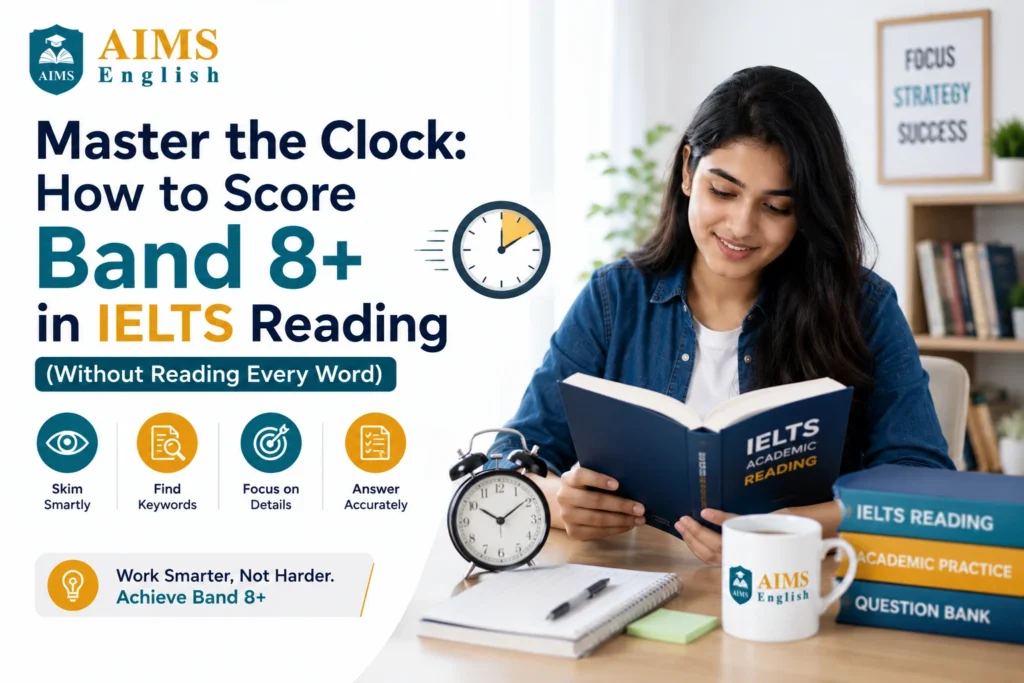
Staring at three massive academic passages with 40 challenging questions and exactly 60 minutes on the clock is a nightmare every IELTS candidate knows too well. Your heart races, the words blur, and suddenly the computer screen flashes, “Five minutes left.”
If you have ever run out of time during an IELTS Reading practice test, you do not have an English problem. You have a strategy problem.
Scoring a Band 8 or higher means getting at least 35 out of 40 questions right. To achieve this, you cannot read like a normal student. You have to read like a detective.
Whether you are a beginner struggling to pass or an advanced learner stuck at Band 6.5, this guide breaks down the practical strategies that consistently help Band 8+ candidates perform under pressure.
The Reality Check: You Do Not Have Time to Read Everything
The biggest myth in IELTS preparation is that you must read the entire passage from beginning to end before answering the questions.
The three passages together contain roughly 2,100–2,750 words. Although many students can read that amount within an hour, doing so leaves very little time to analyse the questions, locate the information, and transfer the answers accurately.
High-scoring candidates do not try to understand every single sentence. Instead, they focus on locating the exact information the questions require. Remember, your goal is not to enjoy the passage—it is to find the correct answers efficiently.
Four Core Reading Skills for Band 8+
To master the IELTS Reading test, every student should develop four essential reading skills:
- Surveying → Preview the passage and predict what it is about.
- Skimming → Understand the overall structure and main ideas.
- Scanning → Locate keywords, numbers, names, dates, and important nouns.
- Close Reading → Read the relevant lines carefully to identify the exact answer.
1. Surveying: Preview Before You Read
This is a step many students skip, but it can save valuable time later.
Before reading the passage, spend around 20–30 seconds looking at the title, subheading, glossary, diagrams, charts, or illustrations if they are provided. These elements give clues about the topic, technical vocabulary, and the type of information you are about to read.
By surveying the passage first, you create expectations in your mind, making it easier to recognise important information while reading.
2. Skimming: Get the Bird’s-Eye View
Skimming means reading quickly to understand the overall structure of the passage.
Spend no more than one to two minutes reading the title and the first sentence of each paragraph. This helps you build a mental map of where different ideas are located, allowing you to return quickly when searching for answers.
3. Scanning: Master the Keyword Hunt
Scanning means searching for specific information without reading everything.
Imagine looking for someone’s name in a phone book. Your eyes move rapidly until they spot a familiar keyword, a number, a capital letter, or another distinctive clue.
Once you locate the keyword, you are already close to the answer.
4. Close Reading: Detect the Traps
After scanning leads you to the correct paragraph, slow down.
Read one or two sentences around the keyword carefully. This is where IELTS examiners hide paraphrases, comparisons, exceptions, and logical relationships that determine the correct answer.
How to Beat the Four Deadliest IELTS Reading Question Types
Different question types require different strategies.
1. True, False, Not Given (TFNG)
This question type is probably the biggest score killer in IELTS Reading.
Remember these definitions:
- True: The passage agrees completely with the statement.
- False: The passage directly contradicts the statement.
- Not Given: The passage neither confirms nor contradicts the statement.
My Favourite Strategy: Use Chunking
One technique I consistently teach my students is chunking.
Instead of reading the statement as one long sentence, divide it into several meaningful chunks or ideas.
Then compare each chunk with the passage.
- If every chunk matches, the answer is True.
- If one chunk directly contradicts the passage, the answer is False.
- If one important chunk is missing entirely, the answer is Not Given.
Thinking in chunks makes TFNG questions much easier because you stop judging the sentence as a whole and begin comparing it idea by idea.
Band 8 Tip: Pay close attention to modifying words such as all, some, always, often, mainly, and only. Small changes in these words frequently change the answer.
2. Matching Headings
These questions test whether you understand the main idea of a paragraph.
Strategy: Many candidates prefer attempting these questions early because they help build a mental map of the passage.
Warning: Do not choose a heading simply because it shares similar vocabulary with the paragraph. IELTS often uses this as a trap. Instead, identify the paragraph’s central message.
3. Multiple Choice Questions (MCQs)
Success in MCQs is not just about finding the correct answer—it’s about eliminating incorrect ones.
Read the question carefully before looking for the answer in the passage. Once you understand the author’s meaning, compare it with the options and eliminate those that do not match.
4. Sentence Completion and Fill-in-the-Blanks
These questions are excellent opportunities to score easy marks.
Always check the word limit carefully, such as “NO MORE THAN TWO WORDS.”
Use grammar clues as well. For example, if the blank follows “an,” the answer should begin with a vowel sound.
The Secret Weapon: Build a Keyword Synonym Matrix
IELTS Reading is largely a test of paraphrasing.
The words in the questions rarely appear exactly the same way in the passage.
Instead of dangerous, the passage may use hazardous, risky, or perilous.
Learning to recognise synonyms is one of the fastest ways to improve your reading score.
Build a Synonym Journal
After every practice test, create a simple two-column table.
| Question Words | Passage Synonyms |
|---|---|
| Vehicles | Automobiles / Cars |
| Cut down | Reduce / Diminish |
| Annual | Yearly / Per annum |
Review this journal regularly. Over time, your brain naturally becomes better at recognising paraphrases.
The Ultimate 60-Minute IELTS Reading Strategy
It’s Not Just Time Management—It’s Skill Management
Many students believe they simply need to manage their time better.
In reality, time problems are usually skill problems.
A student with strong surveying, skimming, scanning, and close-reading skills naturally finishes faster because they know exactly where to look.
That is why I prefer thinking of IELTS Reading as a skill management challenge rather than just a time management challenge.
Once your skills improve, managing the clock becomes much easier.
Use the 17–20–23 Rule
A practical guideline is the 17–20–23 Rule:
- Passage 1 → 17 minutes
- Passage 2 → 20 minutes
- Passage 3 → 23 minutes
Since Passage 3 is generally the most difficult, it deserves the most time.
Enter Your Answers as You Go
One more important reminder: there is no extra time to transfer your answers in the IELTS Reading test.
Enter your answers directly onto the answer sheet—or the computer screen in the computer-delivered test—as you work through each passage.
3 Actionable IELTS Reading Steps to Take Today
Instead of taking endless practice tests without a clear strategy, improve your reading skills deliberately.
1. Read Outside the IELTS Test
Spend 15 minutes each day reading articles from sources like BBC News, National Geographic, or The Economist to build your academic reading stamina.
2. Analyse Your Mistakes
Whenever you answer a question incorrectly, spend time understanding why.
Ask yourself:
- Did I miss a synonym?
- Did I misread a keyword?
- Did I fall for an examiner’s trap?
- Did I simply run out of time?
3. Master Accuracy Before Speed
Practice your surveying, skimming, scanning, and close-reading skills without worrying about the timer at first.
Accuracy develops confidence, and confidence eventually develops speed.
Final Thoughts: Make Band 8+ an Achievable Goal
You already have the tools needed to succeed in IELTS Reading.
Develop these four core skills, strengthen your synonym recognition, and practise strategically rather than endlessly.
With consistent effort, a Band 8+ score becomes an achievable goal—not just an ambitious dream.