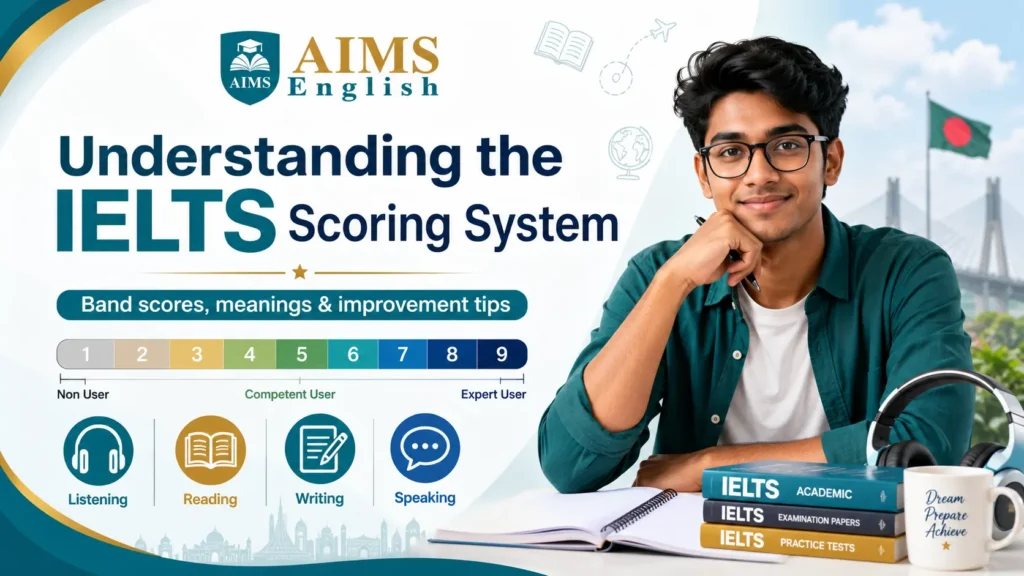
The IELTS (International English Language Testing System) is a widely recognized English language proficiency test. It is used by universities, employers, and immigration agencies to assess a person’s ability to communicate in English. The IELTS test is scored on a scale of 1-9, with 9 being the highest score. In this article, we’ll take a closer look at how the IELTS is scored, what each band score means, and how you can improve your scores.
How is the IELTS scored?
The IELTS test assesses your proficiency in four areas: Listening, Reading, Writing, and Speaking. Each section is scored on a scale of 1-9. Your overall band score is calculated by averaging the scores of the four sections. For example, if you receive a 7 on Listening, an 8 on Reading, a 6 on Writing, and a 7 on Speaking, your overall band score would be 7.
What does each band score mean?
Here is a breakdown of what each band score means:
- Band 9: Expert user – You have full command of the language. Your use of English is appropriate, accurate, and fluent. You can understand complex ideas and communicate effectively in any situation.
- Band 8: Very good user – You have a good command of the language. Your use of English is generally accurate, although there may be occasional errors. You can understand complex language and communicate effectively in most situations.
- Band 7: Good user – You have a good command of the language, but there are some inaccuracies and misunderstandings. You can use and understand complex language, but may struggle in unfamiliar situations.
- Band 6: Competent user – You have an effective command of the language, but there are noticeable inaccuracies and misunderstandings. You can handle basic communication in familiar situations.
- Band 5: Modest user – You have a limited command of the language. You can communicate in basic situations, but there are frequent errors and misunderstandings.
- Band 4: Limited user – You have a basic command of the language, but there are major limitations in your ability to communicate effectively.
- Band 3: Extremely limited user – You have a very limited command of the language. You can only understand and use basic language in familiar situations.
- Band 2: Intermittent user – You have great difficulty understanding spoken and written English.
- Band 1: Non-user – You have no ability to use the language except for a few isolated words.
As you can see, your IELTS band score reflects your overall ability to use and understand English. While achieving a higher score is desirable, it’s important to remember that any score above a 6 is generally considered acceptable for most purposes.
How can you improve your IELTS scores?
Improving your IELTS scores takes time, effort, and practice. Here are a few tips to help you improve your scores:
- Practise, practise, practise! The more you practise, the better you’ll get. Use practice tests to identify your strengths and weaknesses and focus on areas that need improvement.
- Develop your English language skills. Take classes, read books, watch TV shows and movies, and surround yourself with English as much as possible.
- Learn strategies for each section of the test. For example, in the Reading section, you can improve your score by skimming the text for the main idea and scanning for specific details.
- Improve your time management skills. Make sure you’re not spending too much time on any one section of the test.
- Take advantage of resources available to you, such as IELTS prep courses, books, online resources, and practice tests. These resources can help you familiarise yourself with the test format, practise your skills, and gain confidence.
- Seek feedback from qualified IELTS instructors. A qualified IELTS instructor can provide you with personalised feedback on your strengths and weaknesses and help you develop a plan to improve your scores.
Don’t give up! Improving your IELTS scores takes time and effort, but it’s possible with persistence and dedication.
In conclusion, understanding the IELTS scoring system is crucial for anyone preparing to take the test. Your IELTS band score reflects your overall ability to use and understand English, and improving your scores takes time, effort, and practice. By following the tips outlined in this article, you can develop the skills and strategies needed to achieve your desired band score. So, start practising and good luck on your IELTS journey!