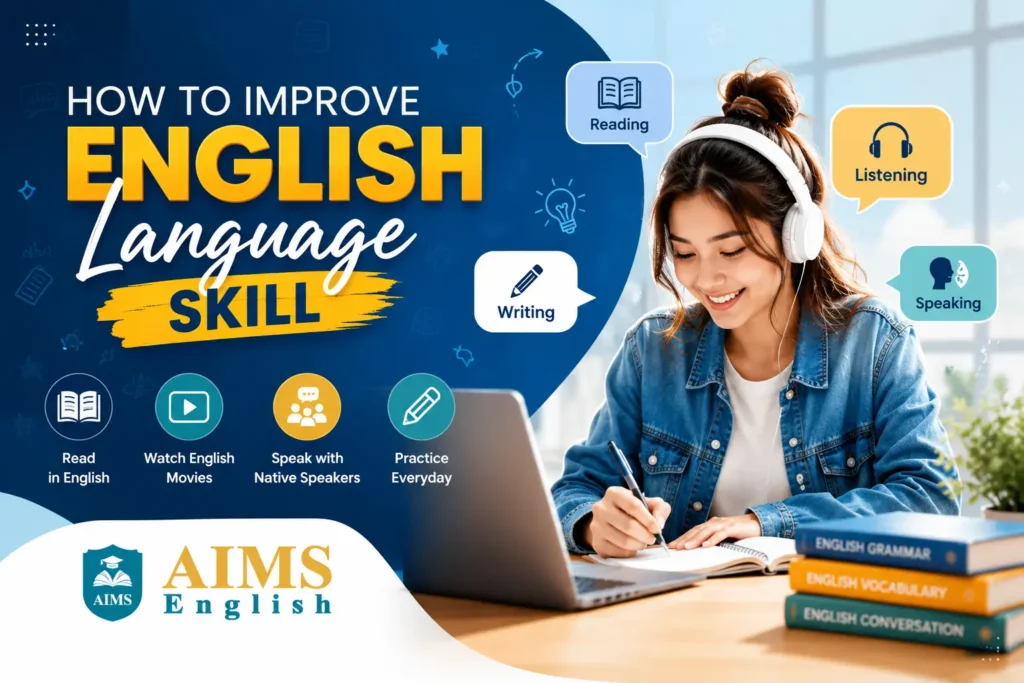
It takes work and a lot of practice to continuously improve one’s English language abilities. It’s imperative to have a mastery of the language, whether it’s to improve your professional chances or to converse more effectively with native speakers. Here are some suggestions to help you become more proficient in the English language.
Start with the basics
Before you start advanced level English classes, it is always better to start with the basics. This includes learning the common vocabulary, grammar rules, and sentence structure.
Read in English
Reading is one of the most effective ways to improve your English skills. It can also help broaden your vocabulary and develop your understanding of sentence structure. Begin with short story books or novels, and as your skill-level grows, advance to longer books.
Watch English Movies or Television Shows
Watching English movies or television shows can help you improve your listening and speaking skills. By listening to how the actors pronounce words and phrases, you can improve your accent, and you can also learn new words and phrases.
Speak with Native Speakers
Speaking with native speakers can help improve your communication skills, as it provides you an opportunity to practise speaking English in a natural manner. This could involve attending social events or joining English-speaking groups.
Important note:Improving your English language skills requires consistent practice, so it’s essential to make time for it every day. Whether it’s writing a paragraph, speaking to someone or listening to English material, take a consistent approach to practising. Improving your English language skills requires effort, commitment, and consistency. It is a long-term process that requires constant practice and learning. With a little patience and determination, even beginners can make significant progress in mastering the language.
A narrative on IELTS reading
The reading module is an important part of the International English Language Testing System (IELTS), which assesses the English language skills of non-native speakers who wish to study, work, or live in English-speaking countries. The reading module is designed to test your ability to read and understand a variety of texts, such as articles, essays, and reports.
The reading module consists of three sections, each of which contains one long text. Each text is followed by 13-14 questions that test your understanding of the text’s content, language, and structure. You have one hour to complete the reading module.
Here are some tips for taking the IELTS reading module
1.Understand the question types
There are various types of questions in the IELTS reading module, such as multiple-choice, true/false/not given, sentence completion, summary completion, matching, and short-answer questions. Familiarise yourself with each question type so that you know how to approach them.
2.Skim and scan the texts
The IELTS reading texts are often dense and complex, so it’s important to skim and scan them to get an overall idea of the content and locate specific information. Skimming means reading quickly to get a general idea of the text, while scanning means looking for particular words or phrases.
3.Highlight key information
When you’re reading the texts, highlight or underline the key information, such as names, dates, numbers, and key ideas. This makes it easier to answer the questions later on.
4.Manage your time
You have one hour to complete the reading module, so manage your time wisely. You may want to spend around 15 minutes on each section, leaving some time at the end to check your answers. Don’t spend too much time on any one question.
Practice, practice, practice
The best way to prepare for the IELTS reading module is to practise as much as possible. You can find sample tests online, or follow IELTS preparation books or follow a specific YouTube channel and try to mimic test conditions as much as possible, such as timing yourself and answering the questions without using a dictionary or other resources.
✪✪✪ The IELTS reading module can be challenging, but with practice and preparation, you can improve your reading skills and achieve the score you need.